Why Indian markets are flashing red signals right now
Why I'm staying on the sidelines. This isn't the time to chase rallies. It's time to wait for real dips.
The geopolitical elephant in the room: The Israel-Iran conflict shows no signs of resolution. These aren't quick skirmishes—we're looking at prolonged tensions. Every escalation ripples through global markets and impacts emerging economies like India.
The rupee problem is REAL. Rapid depreciation against the dollar means foreign investors face headwinds. When they convert INR → USD, they're immediately underwater on returns. That's suppressing buying pressure.
AI GENERATED

The math doesn't work in their favor: If you make 15% in INR but the rupee falls 10%, you're down 5% in USD. FIIs need to see major INR strength OR India-specific growth to justify allocations. Neither is happening.The result? A 10% wipeout is not just possible—it's plausible. Portfolio returns are being eroded faster than retail investors realize. This is why I'm not buying on hope. I'm waiting for fear-driven pricing.
The single most important technical rule I follow:
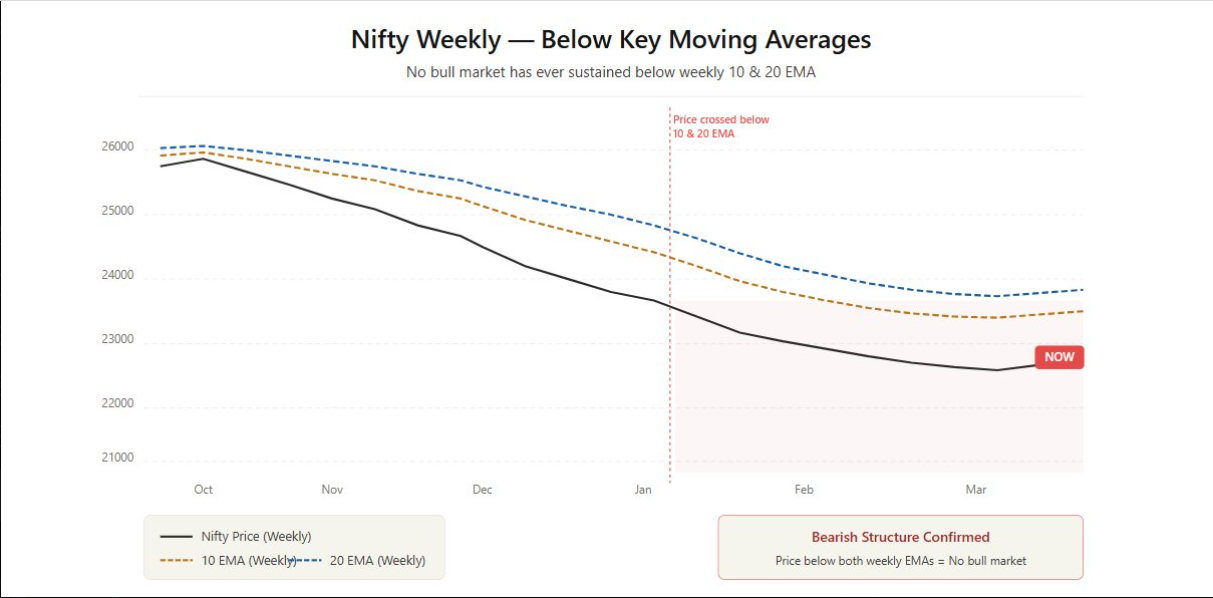
If the indices are trading BELOW their 10 EMA (Blue) and 20 EMA (Yellow) on the WEEKLY timeframe — you do not have a bull market. Period.

Check the history. Every single time Indian indices have fallen below weekly 10 & 20 EMA:
Breakouts failed and reversed quickly
Dip buyers got trapped at higher levels
No new bull leg ever started from below these averages
I’ve been warning since early March that something wasn’t right in the markets.
If you go through my posts and screenshots on Twitter, the signs were clearly there — breakouts were consistently failing, follow-through was missing, and overall sentiment was weak. This is not how a healthy bull market behaves.
Markets don’t crash suddenly out of nowhere — they first show subtle signs of weakness. Lack of sustained breakouts and negative sentiment were early indicators that a dip was likely.
This is why it’s important to focus not just on price, but on market behavior and participation.
Stay alert. Protect capital. Opportunities will always come — but only if you’re still in the game.
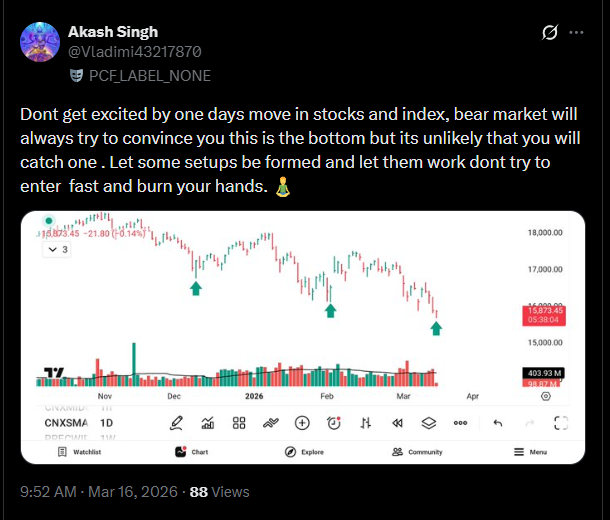


What Next After the Market Fall? My Strategy Going Forward
The market has already fallen — that part is done. The real question now is: what should we do next? When should we enter again?
For me, the answer is very clear and rule-based.
I follow the philosophy of William O’Neil, one of the greatest traders and investors in market history. His approach is simple but powerful — wait for confirmation, not prediction.
I am not interested in catching bottoms. I am interested in catching strength.
My Plan to Re-enter the Market
I will only start buying when the market proves itself again. Specifically:
I will wait for a proper breakout above the longest and most important resistance level — what I call the main breakout.
The index must show strength by sustaining above key levels (like 10/20 moving averages) and trending higher, especially on the weekly timeframe.
Price action must confirm that institutions are back and stocks are ready to move.
Until then, patience is my position.
Data Over Noise
One thing I am absolutely clear about:
I do not trade news. I trade data.
It doesn’t matter to me:
What geopolitical events are happening
Whether there is war or peace
Whether headlines are positive or negative
If the market reacts positively and shows strength, I will participate.
If the market reacts poorly, I will stay away.
The market is the final truth — everything else is just noise.
Aggression Only When Confirmed
When the market confirms strength:
I will deploy capital aggressively
I will increase position sizes
I may even use leverage, but only when price action supports it
But until that confirmation comes, I will remain disciplined and defensive.
The O’Neil Approach: Confirmation Over Speculation
Even if the market feels "oversold," I recognize that short-term price action is unpredictable. A falling market has no floor, and I refuse to gamble on a bottom that hasn't formed yet.
Buy above green line.

Why I Don’t Try to Catch the Bottom — And What I’ll Do Instead
One thing is very clear in my mind:
I am not here to catch the bottom, and I am not trying to be smart.
I don’t know where the bottom is — and more importantly, I am not interested in finding it.
What I do know is this:
I will make the most money when the market revives — because I will be positioned based on data, not hope.
No Hope, Only Data
I will not sit and wait, hoping for a recovery.
I will act only when the market gives confirmation.
Yes, I may enter late in the rally — but that doesn’t bother me.
Because when I enter:
My position sizing will be strong
My timing will be backed by data
I will start making money from the day I enter, not after months of waiting
This is the difference between emotional investing and rule-based investing.
Aggression With Confirmation
Once the market confirms strength, I will not hesitate:
I will deploy capital aggressively
I may use high leverage, but only when supported by price action
Every decision will be based on data, not opinions or news
Risk Management Is Non-Negotiable
No matter how confident I am, I follow strict rules:
I never allocate more than 35–40% of my capital to a single stock
I never risk more than 5% on any individual position
These rules are not easy to follow.
They require experience, discipline, and deep analysis — especially when working with tight stop losses.
But this is what keeps me in the game.
For Long-Term Investors
For those with a 2–3 year investment horizon, this phase can actually be a good opportunity.
It’s a reasonable time to start or continue SIPs
But I would suggest: don’t go all in right now
Consider reducing your SIP allocation by around 50%
Increase allocation only when the market crosses key resistance levels and shows strength
Markets move in cycles:
They can stay sideways for 2–3 years
And then rally sharply in a short period, delivering most of the gains
Your job is not to predict — but to be ready to capture that move.
Learn, Adapt, and Think Independently
Try to:
Learn continuously
Connect with knowledgeable people
Build your own understanding of the markets
Because if you study the data, you’ll realize that only a small number of mutual funds consistently outperform the market.
Final Note
This is my approach. This is how I trade and invest.
I am not a SEBI-registered advisor, and this is not financial advice.
This is purely for educational purposes and to share my thought process.
At the end of the day, the responsibility of capital is yours.
Trade smart. Stay disciplined. Protect capital — and wait for the right moment.
Thanks for reading
Have a good day :)